Spanish Squats: Banded Setup, Knee Rehab & Spanish Squat vs Wall Sit
A Spanish squat is a specialized knee-friendly squat variation performed with a thick resistance band or rigid strap anchored behind the knees. By bracing the shins in a strictly vertical alignment and keeping the torso upright, the setup shifts load directly onto the quadriceps and patellar tendon while reducing compressive force at the kneecap — making it the gold standard in sports physiotherapy for knee rehab and isolated quad strengthening.
The movement was developed and popularized by prominent Spanish sports physiotherapist Ángel Basas for treating chronic patellar tendinopathy in Olympic athletes. In clinical literature, it is frequently cataloged as the Basas Spanish squat or simply the “Basas squat” (clinical trial case series).
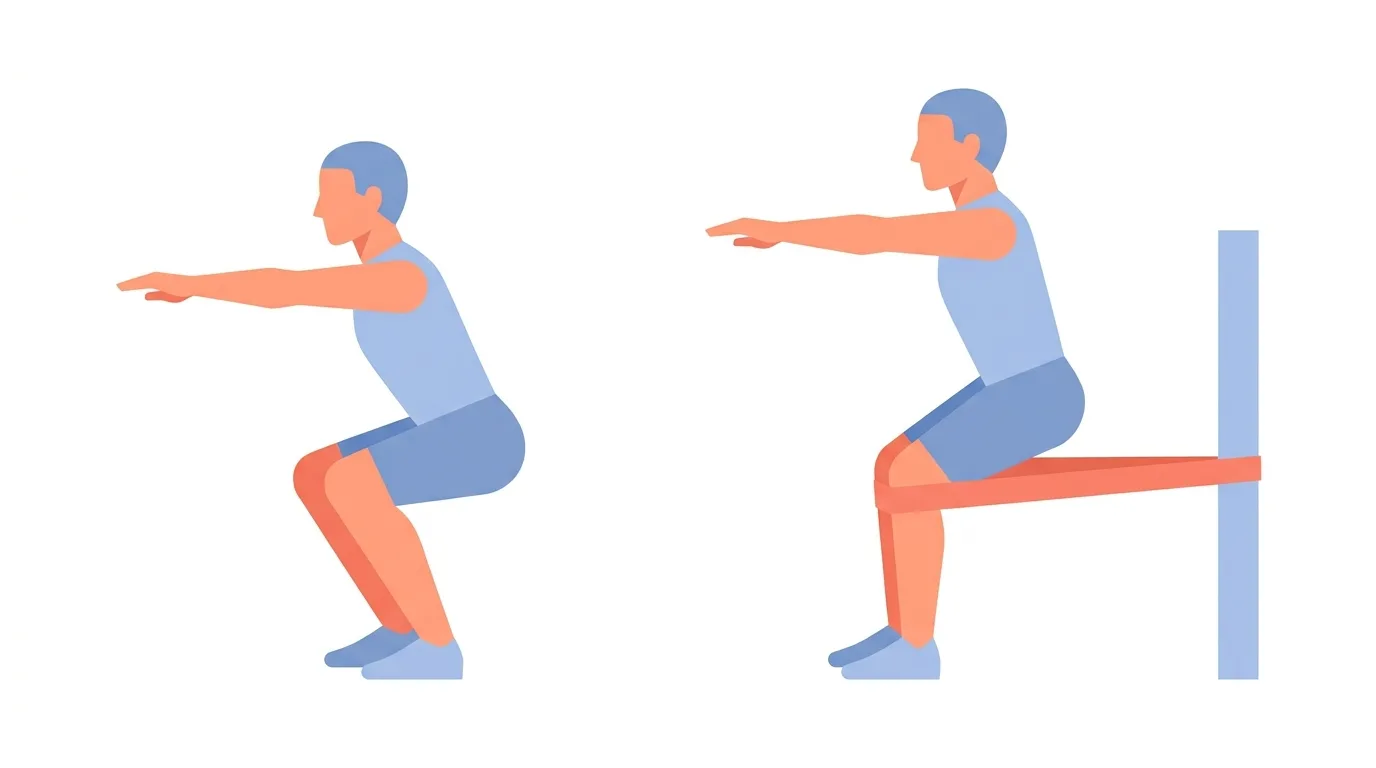
How a Spanish Squat Differs from a Regular Squat
In a standard bodyweight or barbell squat, your knees naturally travel forward and your shins angle forward as your hips descend. While healthy knees tolerate this forward shear well, athletes with patellar tendinopathy (jumper’s knee) or anterior knee irritation experience sharp compression between the patella and femur.
The band anchored behind your knees provides a constant horizontal counterforce: it restrains forward knee excursion, allowing you to sit straight down and back while keeping your shins completely perpendicular to the floor.
| Biomechanical Factor | Standard Bodyweight Squat | Spanish Squat with Band |
|---|---|---|
| Shin Angle | Angled forward (knees track over toes) | Strictly vertical (90° to the floor) |
| Torso Posture | Moderate forward torso lean | Completely upright |
| Quadriceps Activation | Moderate (spread across hip & knee) | Extremely high (isolated knee extension moment) |
| Patellofemoral Shear Force | Higher peak compressive load | Substantially reduced |
| Equipment Needed | None | Heavy-duty loop band + sturdy anchor |
| Primary Fitness Focus | General strength & daily habit | Quad hypertrophy, tendon rehab, pain-free loading |
Electromyographic (EMG) studies confirm significantly higher rectus femoris and vastus lateralis activation during Spanish squats compared to standard squats or goblet squats at identical knee flexion angles.
Spanish Squats with Band: Step-by-Step Setup & Anchor Guide
To set up a safe, stable Spanish squat at home or in the gym:
Required Equipment: A short, heavy-duty loop resistance band (often sold as a 40–80 lb pull-up assist band) or a dedicated rigid nylon physio strap, and an immovable anchor at knee height (power rack upright, sturdy staircase pillar, or heavy structural column).
- Loop the Band: Secure the band around your anchor so both loops hang parallel at exactly knee height.
- Step Into Position: Step inside both loops so the band sits directly in the popliteal crease behind both knees (just below the joint line, never on the mid-calf).
- Establish Tension: Step backward until the band is firmly stretched and pulling your knees forward toward the anchor point.
- Foot Stance: Place feet shoulder-width apart, toes pointed forward or angled slightly outward (5° to 10°).
- Sit Back into the Band: Sit your hips down and back as if aiming for an invisible low chair. Push your shins backward against the band resistance to maintain vertical shins.
- Depth: Descend until your thighs reach roughly parallel (70° to 90° knee angle). Keep your chest proud and spine neutral.
- Hold or Rep:
- Spanish Squat Isometric Hold: Freeze in the parallel position for 30 to 45 seconds, breathing smoothly.
- Dynamic Repetitions: Press through your midfoot and heels to return to standing, taking 3 seconds down and 3 seconds up.
Bodyweight Spanish Squat vs Weighted Variations
For most individuals rehabilitating sore knees or rebuilding baseline quad strength, a bodyweight Spanish squat (using only your own body mass supported by the band) delivers intense muscular tension.
Once you can comfortably hold 45 seconds bodyweight without discomfort, you can progress by holding a light kettlebell or dumbbell in a goblet hold at chest height, or by moving to a thicker band for greater resistance.
Spanish Squat Hold vs Wall Sit: Biomechanical Comparison
A common question is whether a simple wall sit can replace a Spanish squat hold. While both exercises feature an upright torso and vertical shins, their muscular activation patterns differ fundamentally:
| Feature | Spanish Squat Hold | Wall Sit |
|---|---|---|
| Support Mechanism | Elastic horizontal tension at knee crease | Rigid vertical wall supporting entire back |
| Core & Hip Stabilizers | Active: Core, hips, and glutes must stabilize balance | Passive: Back rests flat against the wall |
| Quadriceps Isolation | Extreme: Continuous resistance against knee extension | Moderate: Static friction holds body in place |
| Tendon Remodeling Stimulus | High continuous tensile strain on patellar tendon | Lower peak strain due to wall support |
| Portability & Setup | Requires anchor post + heavy band | Requires only a flat wall |
Verdict: While wall sits are convenient for beginners, Spanish squat holds are superior for patellar tendinopathy recovery and pure quad hypertrophy because your nervous system must actively fight the band’s pull, generating significantly greater neuromuscular recruitment without patellofemoral friction.
Spanish Squat Isometric Protocol for Patellar Tendon Pain
In sports medicine, heavy isometric loading produces a well-documented cortical inhibition and analgesic effect — temporarily dulling tendon pain and allowing pain-free movement afterward:
| Training Goal | Spanish Squat Protocol | Recommended Frequency |
|---|---|---|
| Knee Pain Relief (Isometric) | 4–5 sets × 45-second isometric hold (2 min rest between) | Daily or as a pre-workout primer |
| Tendon Remodeling (Slow Eccentrics) | 4 sets × 8–10 slow reps (3 sec down, 3 sec up) | 3 times per week (alternate days) |
| Quad Hypertrophy | 3–4 sets × 10–12 reps with goblet dumbbell | 2–3 times per week |
| Squat Workout Warm-Up | 2 sets × 25–30 second hold | Prior to main squat sessions |
Clinical guidelines from Strength Resurgence recommend strictly controlling tempo during dynamic reps: avoiding explosive reversals protects healing collagen fibers.
To progress: use a thicker or doubled band, hold a dumbbell or plate at chest height, or increase hold duration.
What we noticed at MeshyFit
When a team member dealt with mild knee discomfort from desk-to-squat transitions, we added Spanish squats as a warm-up before testing the rep counter. Two observations:
- 30-second isometric holds made the subsequent bodyweight squats feel smoother. The quads “woke up” without aggravating the knee — consistent with the analgesic effect reported in clinical settings.
- The counter did not reliably track the rep version. Because the hip doesn’t travel through the same arc as a free-standing squat, pose landmarks shift less — our depth threshold triggers inconsistently. We treat Spanish squats as a timer-based accessory, not a counted exercise in the app.
Common mistakes
- Band too low (mid-calf): changes the force angle and can slip. Keep it just below the knee joint line.
- Leaning forward: makes it a regular squat with a band. Stay upright.
- Bouncing at the bottom: defeats the time-under-tension goal. Control the movement.
- Using a thin band: won’t support your weight. Use a short, thick loop band rated for pull-ups or similar.
- Going too deep for your mobility: if your shins start angling forward, you’ve passed your useful range.
Important note
Spanish squats are widely used in knee rehabilitation, but this article is general movement education — not a substitute for professional assessment. If you have diagnosed tendinopathy, a PT or sports physio should guide your loading protocol. Sharp pain during the exercise means stop.
FAQ
Spanish squat hold vs wall sit — which is better for bad knees?
While both keep shins vertical and protect the patellofemoral joint, the Spanish squat hold is generally superior for patellar tendon rehab. In a wall sit, friction against the wall passively supports your torso. In a Spanish squat hold, your nervous system must actively recruit the quadriceps and hip stabilizers against the band’s forward pull, maximizing tendon load without joint friction.
Can I do a bodyweight Spanish squat without extra weights?
Yes. In fact, sports physiotherapists recommend starting exclusively with a bodyweight Spanish squat. The mechanical leverage created by the vertical shin produces intense quad recruitment on its own. Only add dumbbells or kettlebells after you can comfortably hold 45 seconds pain-free.
Can I do Spanish squats at home?
Yes. You need a thick loop band and a sturdy, immovable anchor at knee height — heavy table leg, railing post, structural pillar, or door anchor.
Related reading
- Squatting with Knee Pain: Causes & Modifications — complete guide to pain-free squatting.
- Deep Squats vs Parallel Squats Biomechanics — joint forces across different squat depths.
- 20 Squats a Day for 30 Days — full physiological adaptation timeline.
- Squat Workout: Complete Exercise Guide — where Spanish squats fit in a full training session.
- Squat Form for Beginners — master the regular bodyweight squat first.
- Bodyweight and Air Squat Workouts — equipment-free routines.
- MeshyFit Squat Counter — automatic rep counting for standard workout squats.
About the authors
Written by the MeshyFit Team — builders of a privacy-first iPhone squat counter. We practice the exercises we write about but are not licensed clinicians. Nothing here is medical advice.