Asian Squat Explained: Deep Resting Squat vs Workout Squats
An Asian squat is a flat-footed deep resting squat: hips sink toward the heels, heels stay down, and you stay at the bottom to rest — not to pump reps. Coaches often prefer the label deep resting squat because it names the posture and purpose without implying ethnicity.
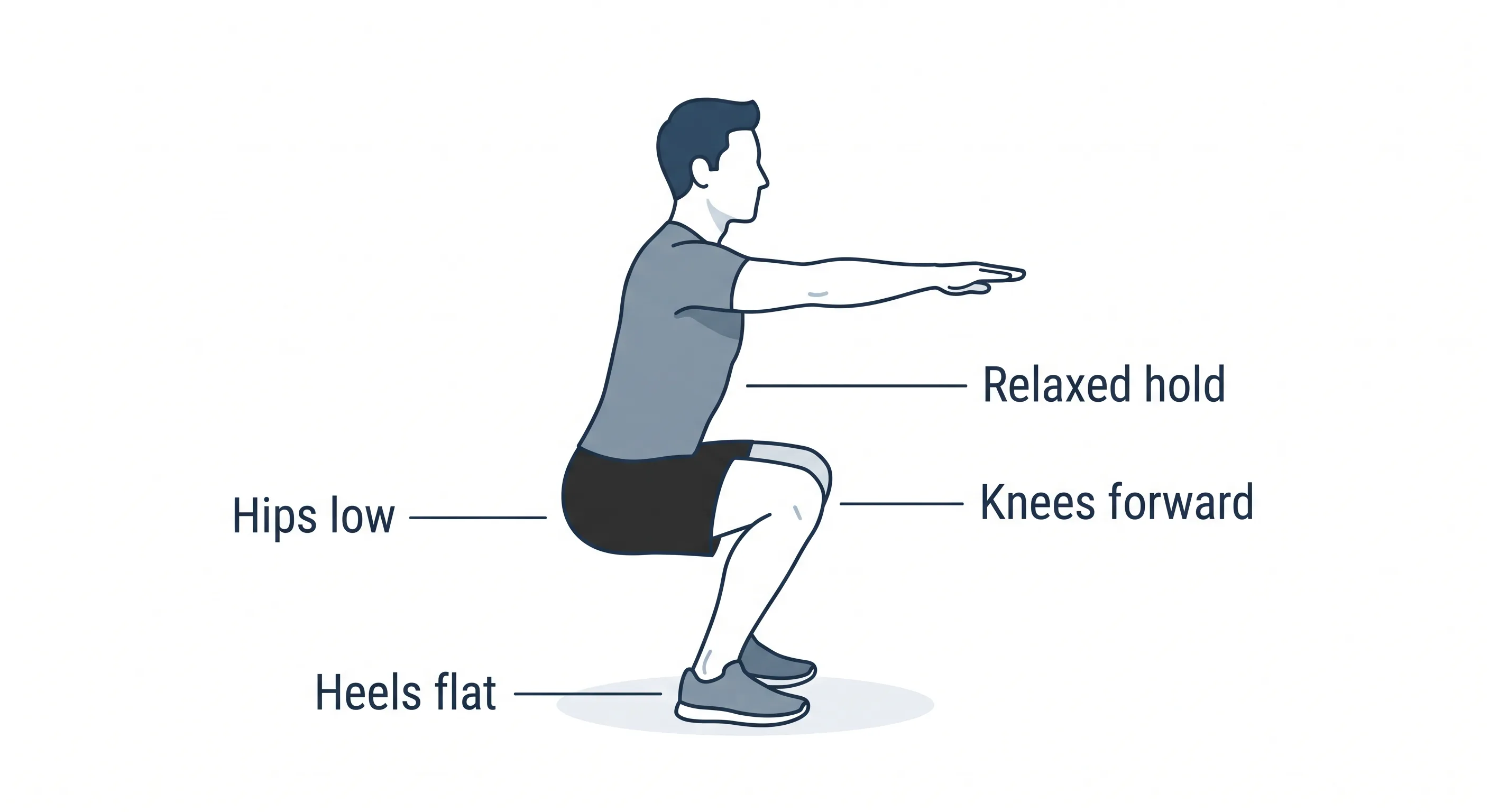
Diagram note: The illustration highlights the same cues people search for — heels flat, hips lower than a shallow squat, knees tracking forward, a calm hold. It is a teaching view, not a photo of the deepest “hips-to-heels” rest. Full resting depth varies by ankle and hip mobility; go only as low as you can keep heels down and stay balanced.
People still use that posture to wait, work near the ground, or sit without a chair — something Macao News notes remains ordinary in daily life even as chairs dominate elsewhere. Kids usually do it easily. Many adults lose it after years of chairs and heeled shoes. If you struggle, the usual reason is stiff ankles and hips — plus lack of practice — not genetics.
What we noticed practicing this for MeshyFit
While building MeshyFit’s on-device squat cues, we practiced short resting holds the same week we tuned workout-rep depth checks. Two patterns showed up quickly:
- Heels lift before depth fails. If the feet tip onto the toes, a doorframe or a thin towel under the heels usually restores balance long enough to breathe in the bottom — then we remove the help gradually.
- Resting and counting are different skills. A calm 30-second hold does not feel like a set of air squats. Our counter is built for the up-and-down workout pattern, so we never treat a long resting hold as “reps completed.”
That hands-on split is why this article separates mobility holds from counted training.
Asian squat vs bodyweight squat (air squat)
They look similar. They are not the same job. Guides that compare resting and loaded squats make the same split: one position is for holding and mobility; the other is for training reps.
| Asian / resting squat | Bodyweight / air squat | |
|---|---|---|
| Purpose | Hold and rest; build comfort in deep range | Strength and conditioning reps |
| Depth | Often hips near heels when mobility allows | Parallel or slightly below for most workouts |
| Heels | Flat is the goal | Flat preferred for solid form |
| Spine | Can stay relaxed when unloaded | Stay controlled throughout each rep |
| Time | One hold for seconds to minutes | Up and down for sets |
An air squat is simply a bodyweight squat done for reps — stand, sit the hips down, stand again. Why that matters here: resting holds help you own depth; workout squats build strength and a habit you can count. MeshyFit is built for the second — short challenges with on-device rep counting and non-clinical feedback. It does not count a long resting Asian squat hold as a workout. Practice the hold for mobility; use bodyweight or air squats when you want measurable reps.
For workout form, see Squat Form for Beginners. For home routines, see Bodyweight and Air Squat Workouts.
What makes the position hard
A deep resting squat needs several joints working together:
- Ankles — enough forward bend (dorsiflexion) so knees can travel over the toes while heels stay down
- Hips — deep fold; a slightly wider stance or more toe-out often feels better
- Knees — deep bend under your body weight only
- Balance — weight staying over the mid-foot, not tipping onto the toes
Reporting summarized by Macao News notes that passive ankle dorsiflexion is much larger in newborns (around 60°) and often much smaller in adulthood (around 20°) — one reason chair-heavy lifestyles make a flat-heeled deep squat feel foreign. Fitness guides aiming at the resting position often cite roughly 35–38° of ankle dorsiflexion as a practical target range for a comfortable deep squat, versus averages nearer ~30° in sedentary adults (FitnessApie overview). Treat those numbers as directional context from secondary reporting, not a personal diagnosis.
If heels lift first, treat that as feedback, not failure. Resting-squat practice guides often suggest widening the stance, turning the toes out, holding a doorframe, or using a thin heel wedge while you learn the shape. Those are shortcuts that help you train the position — not cheating.
This is general movement education, not medical advice, injury prevention, or clinical assessment. Sharp joint pain means stop. Mild stretch is different. If you already have joint problems, ask a qualified professional before forcing depth.
How to practice a deep resting squat
- Feet about shoulder-width (or a bit wider), toes turned out as needed.
- Sit the hips back and down; let knees track over the toes.
- Keep heels heavy on the floor — or on a small towel wedge if you need it.
- Go only as deep as you can stay balanced and calm.
- Hold 20–40 seconds, breathe slowly, then stand.
- Do 2–4 short holds a few days each week.
Easier: doorframe or counter for balance; slight heel lift; less depth.
Harder: less hand support; flatter heels; longer relaxed holds (still no weight).
Do not force depth or treat this like a max lift. Short, frequent practice beats one painful attempt.
FAQ
Is the Asian squat only for Asian people?
No. The name is search shorthand for a deep, flat-footed resting squat. Movement writers covering Asian squat benefits and who it’s for make the same point: the posture is cultural practice and joint range, not an ethnic ability. Lifestyle and practice explain most of the gap between kids and desk-bound adults.
Are Asian squat, resting squat, and deep squat the same?
In everyday fitness writing, yes when you mean an unloaded hold with heels down and hips deep. The Slav squat is the same idea with Eastern European cultural framing. Air squat and bodyweight squat mean the up-and-down exercise version.
Will practicing an Asian squat improve my workout squats?
It can make deep hip and ankle positions feel less foreign, so parallel depth in training may feel easier. It does not replace progressive bodyweight or loaded training. Keep resting holds and counted workouts as separate tools.
Can MeshyFit count Asian squats?
MeshyFit counts standard workout squats (bodyweight / air-squat style reps) with on-device pose estimation. It is not built to score long resting holds as reps. Use the resting squat for mobility; open the app for a short counted challenge — see the squat counter app overview.
Next steps
- Practice short resting holds (use support if you need it).
- Learn workout form in How to Do Bodyweight Squats.
- Run a home session from At-Home Bodyweight Squat Workouts.
- For automatic reps with no video upload, try MeshyFit’s squat counter.
About the authors
Written by the MeshyFit Team — builders of a privacy-first iPhone squat counter. We write beginner squat guides from product work (on-device counting, form cues, weekly commitment) and from practicing the movements ourselves. We are not clinicians; nothing here is medical advice.