Dumbbell & Kettlebell Squats: Grip Options, Form & Home Overload
Dumbbell squats and kettlebell squats are the practical home path from bodyweight volume to progressive overload: same squat pattern, added external load through different grips.
This page covers the grip family—side-loaded dumbbells, DB/KB front rack, suitcase holds, and when to use each—without rewriting the full goblet squat lesson. If your only weight is hugged at the chest, start with the goblet guide; if you have a pair of bells or want rack/side options, stay here.
Training note: Add load only after you can perform controlled bodyweight squats with consistent depth. This is general fitness education, not medical advice.
Dumbbell vs Kettlebell for Squats
| Factor | Dumbbells | Kettlebells |
|---|---|---|
| Best beginner entry | Light pair at sides, or one DB goblet | Single KB goblet or rack |
| Grip comfort | Neutral handles; easy side holds | Offset handle; rack sits on forearms |
| Load progression | Fine jumps if you own a pair set | Often larger jumps per bell size |
| Stability demand | Two equal DBs feel balanced | Single-bell suitcase increases anti-lateral challenge |
| Home practicality | Adjustable DBs scale well | One or two KBs cover many patterns |
You do not need both tools. One pair of dumbbells or one mid-weight kettlebell is enough to progress for months.
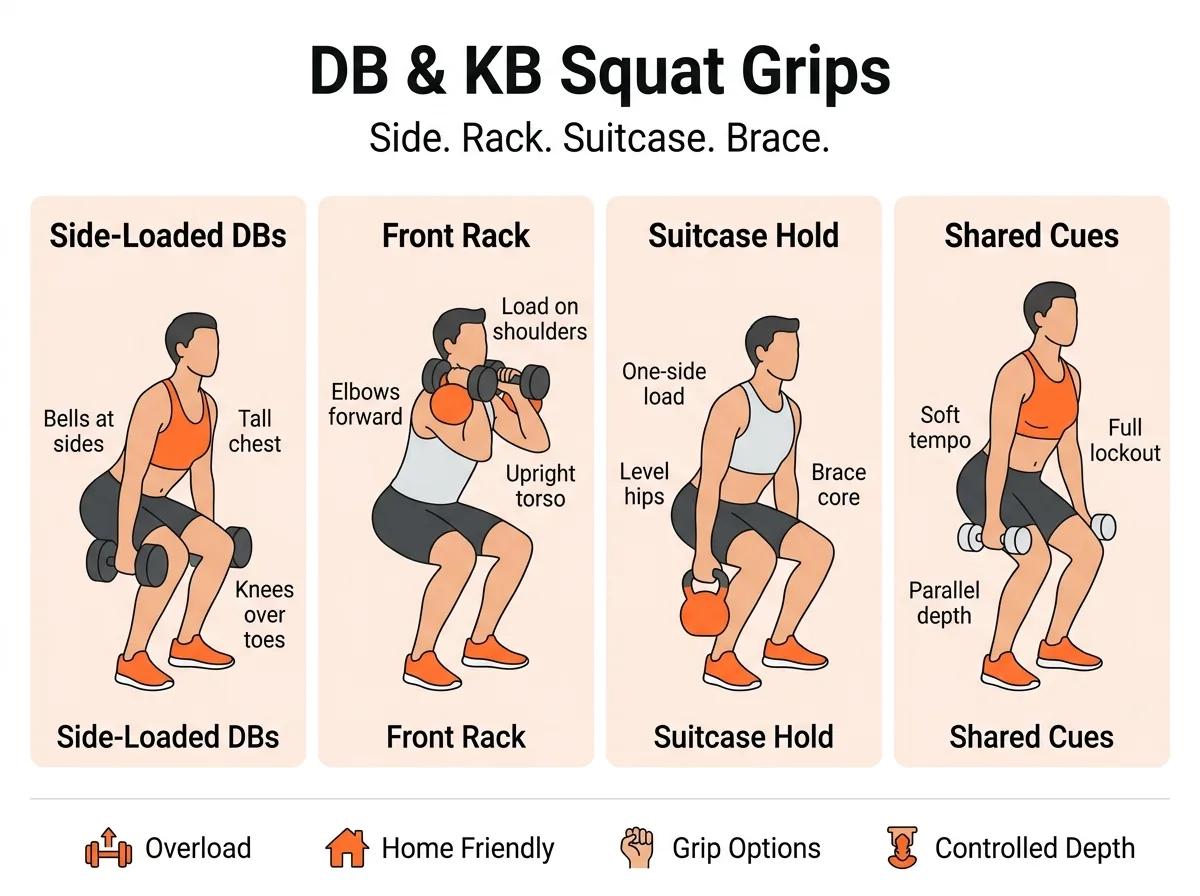
Four Useful Grip Setups
1. Side-loaded / suitcase dumbbell squat (most common “DB squat”)
Hold a dumbbell in each hand at your sides, arms long, wrists neutral. Stand shoulder-width, brace, sit to parallel, then drive up without shrugging the bells.
Best for: Straightforward bilateral overload when you already own air-squat depth.
Watch for: Shoulders rolling forward—pack the lats lightly so the bells hang quietly.
2. Dumbbell front-rack squat
Rest the heads of two dumbbells on the fronts of your shoulders, elbows pointing roughly forward/slightly down. Keep the chest tall as you squat.
Best for: Teaching an upright torso under load (similar intent to a front squat).
Watch for: Elbows collapsing and bells sliding—use a lighter pair until the rack feels locked.
3. Kettlebell rack squat (single or double)
Clean or curl the bell(s) so the handle rests against the forearm/chest shelf, elbow(s) down. Squat with the same depth rules as bodyweight work.
Best for: Compact home loading with one or two KBs; strong core demand.
Watch for: Overarching the lower back to “hold” a heavy rack—reduce load and re-brace.
4. Single-bell suitcase squat
Hold one DB or KB at one side only. Squat while resisting the lean toward the load; switch sides each set or alternate reps carefully.
Best for: Anti-lateral core work and fixing side-to-side imbalances.
Watch for: Hip hiking—keep the belt line level; go lighter if you tip.
Goblet reminder: Chest-hold technique, elbow-to-knee depth cues, and water-jug substitutions live on the goblet squat page—link out rather than duplicating that checklist here.
Shared Form Checklist (Any Grip)
Weighted Squat Checklist:
- Feet: Shoulder-width (or your proven stance), toes slightly out.
- Brace: Inhale, ribs stacked over pelvis before the first inch of descent.
- Depth: Aim for a consistent parallel target you already own unloaded.
- Knees: Track over mid-foot; do not let them cave as the bells get heavy.
- Finish: Stand tall to full hip extension without hyperextending the low back.
Tempo cue
Lower for about two seconds, pause briefly if needed, then stand with control. If the weight swings, the load is too heavy or the eccentric is too fast.
Muscles Worked
| Muscle Group | Role with DB / KB load |
|---|---|
| Quadriceps | Primary knee extension under added resistance |
| Gluteus maximus | Hip extension and lockout, especially from deeper positions |
| Adductors | Stance stability; more with wider setups |
| Upper back & lats | Keep side-loaded or racked bells from pulling you forward |
| Core | Anti-flexion (front rack) and anti-lateral (suitcase) demand |
| Forearms / grip | Limiters on heavy side-loaded sets—train grip or use straps only if needed |
4 Common Mistakes & Fixes
Mistake 1: Depth disappears when the weight appears
- Problem: Parallel becomes a shallow dip as soon as bells feel heavy.
- Fix: Drop the load until depth matches your best air squat, then rebuild.
Mistake 2: Rounded upper back with side-loaded DBs
- Problem: Heavy hanging bells drag the shoulders into a slump.
- Fix: Light lat pack, proud chest, shorter sets; consider front rack or goblet instead.
Mistake 3: Knees cave on the concentric
- Problem: Valgus under fatigue, especially with suitcase or uneven loads.
- Fix: Cue “knees out over toes,” reduce load, or temporarily return to bilateral even DBs.
Mistake 4: Bouncing out of the bottom
- Problem: Rebound hides weak control and stresses tendons.
- Fix: Soft pause at the bottom; own the position before driving up.
Home Overload Without a Full Gym
| Tool | How to use it | Progression idea |
|---|---|---|
| Pair of DBs | Side-loaded or front rack | Add 2–5 lb per hand when 3×10 feels easy |
| One KB | Goblet or rack | Move up one bell size when depth stays clean |
| Water jug | Goblet-style hug | Fill gradually; treat as a goblet progression |
| Backpack | Hug or wear high on the back | Add books slowly; keep torso braced |
Progress one variable at a time: load, reps, or sets—not all three in the same week.
Sample 20-Minute DB / KB Squat Strength Session
Warm up with 1–2 minutes of unloaded squats first.
| Movement | Sets × Reps | Rest | Focus |
|---|---|---|---|
| Side-loaded DB squats | 3 × 8–10 | 90 s | Bilateral strength |
| KB or DB front-rack squats | 3 × 6–8 | 90 s | Upright torso under load |
| Suitcase squats (each side) | 2 × 6 | 60 s | Anti-lateral control |
| Bodyweight air squats | 2 × 12 | 45 s | Easy volume finisher |
Run this 1–2 times per week on days you want overload. Keep other days lighter with bodyweight habit volume.
Dual-Track Training with MeshyFit
Weighted days build strength. Habit days build consistency. You can use both without forcing every set through a camera.
Suggested split:
- Strength days: Dumbbell or kettlebell squats with a notebook or simple timer for sets/reps.
- Habit / challenge days: Controlled bodyweight squats counted hands-free with MeshyFit on iPhone.
MeshyFit helps on the habit track:
- On-device rep counting for workout / bodyweight squat patterns
- Depth-oriented validation for clear stand-to-depth cycles
- No video upload — inference stays on device
Honest bridge: MeshyFit is built for countable squat cycles, not for detecting whether you are holding a dumbbell or kettlebell. Use bells for overload; use the app when you want frictionless bodyweight volume and challenge tracking.
Download MeshyFit for iOS and pair loaded strength work with on-device habit counting.
Related Guides, Workouts & Variations
- Goblet Squat Form & Home Progression — Chest-hold technique in depth.
- Sumo Squat: Wide Stance & Inner Thigh Focus — Stance bias for glutes/adductors; can add a single bell.
- Jump Squat: Power & Plyometric Progressions — Explosive bodyweight finisher (unload first).
- Beginner Squat Workout — Own air squats before heavy bells.
- How to Squat Properly — Foundational stance and depth.
- Squat Calorie Calculator — Estimate energy cost of squat volume.
Frequently Asked Questions
- What is a dumbbell squat?
- A dumbbell squat is any squat where you hold one or two dumbbells for progressive overload—most often at your sides (suitcase/side-loaded), in a front-rack position at the shoulders, or in a goblet hold at the chest. The squat pattern stays the same: sit hips down and back, keep knees tracking over toes, then stand tall.
- What is a kettlebell squat?
- A kettlebell squat uses one or two kettlebells instead of a barbell. Common setups are a single-bell goblet hold, a single- or double-bell front rack against the forearms, or a suitcase hold at the side. The bell’s offset handle changes grip comfort, but depth and knee-tracking rules match other squats.
- Dumbbell squat vs goblet squat — what’s the difference?
- Goblet squat is a specific anterior-loaded pattern: one weight hugged at the chest. Dumbbell squats are a broader family that includes goblet holds plus side-loaded pairs, front-rack DBs, and suitcase variations. Use this page for grip options and overload; use the dedicated goblet guide for chest-hold technique detail.
- How heavy should dumbbell or kettlebell squats be?
- Choose a load you can control for 6–12 quality reps with consistent parallel depth and an upright-enough torso. Beginners often start with a single light bell or household substitute; add weight only when the last 2 reps still look like the first 2.
- Can I do weighted squats at home without a gym?
- Yes. Two dumbbells, one kettlebell, a filled water jug, or a loaded backpack can provide progressive overload. Prioritize stable footing and a clear landing zone; stop a set if grip or posture collapses before the legs do.
- What are the most common dumbbell and kettlebell squat mistakes?
- Common errors are: (1) letting side-loaded bells pull the shoulders forward into a rounded upper back; (2) cutting depth as soon as the weight feels heavy; (3) knees collapsing inward under fatigue; and (4) rushing the eccentric so the load swings. Fix with braced core, controlled 2-second lowers, and lighter bells until depth returns.