Jump Squat: Form Guide, Power Benefits & Plyometric Progressions
The jump squat (also called a jumping squat or plyo squat) turns a standard bodyweight squat into an explosive power move: squat down, drive through the floor, leave the ground, and land quietly before the next rep.
It is popular in HIIT circuits, athletic warm-ups, and home conditioning because it trains rate of force development—not just slow strength. Use it when you already own a controlled air squat and want a higher-intensity finisher, not as your first squat lesson.
Impact note: Jump squats are higher-impact than air squats. If landings feel harsh, reduce jump height, shorten the set, or switch to controlled bodyweight squats. This page is general fitness education, not medical advice.
Jump Squat vs Regular Bodyweight Squat
| Feature | Bodyweight (Air) Squat | Jump Squat |
|---|---|---|
| Concentric intent | Controlled stand-up | Explosive vertical drive |
| Feet leave floor? | No | Yes (brief flight) |
| Primary training effect | Strength endurance, form practice | Power, conditioning, fast-twitch demand |
| Landing demand | Low | Higher impact; needs soft knees |
| Best for | Daily habit volume, beginners | Short power sets, HIIT finishers |
| Fatigue pattern | Muscular | Muscular + cardiovascular + connective tissue |
When to choose jump squats
- You can hit consistent depth and lockout on air squats.
- You want denser conditioning in fewer minutes.
- You are training athletic qualities (vertical drive, quick hips).
When to stay with air squats
- You are still learning stance, depth, and knee tracking.
- Landings feel jarring or noisy.
- You are accumulating high daily squat volume and need lower impact.
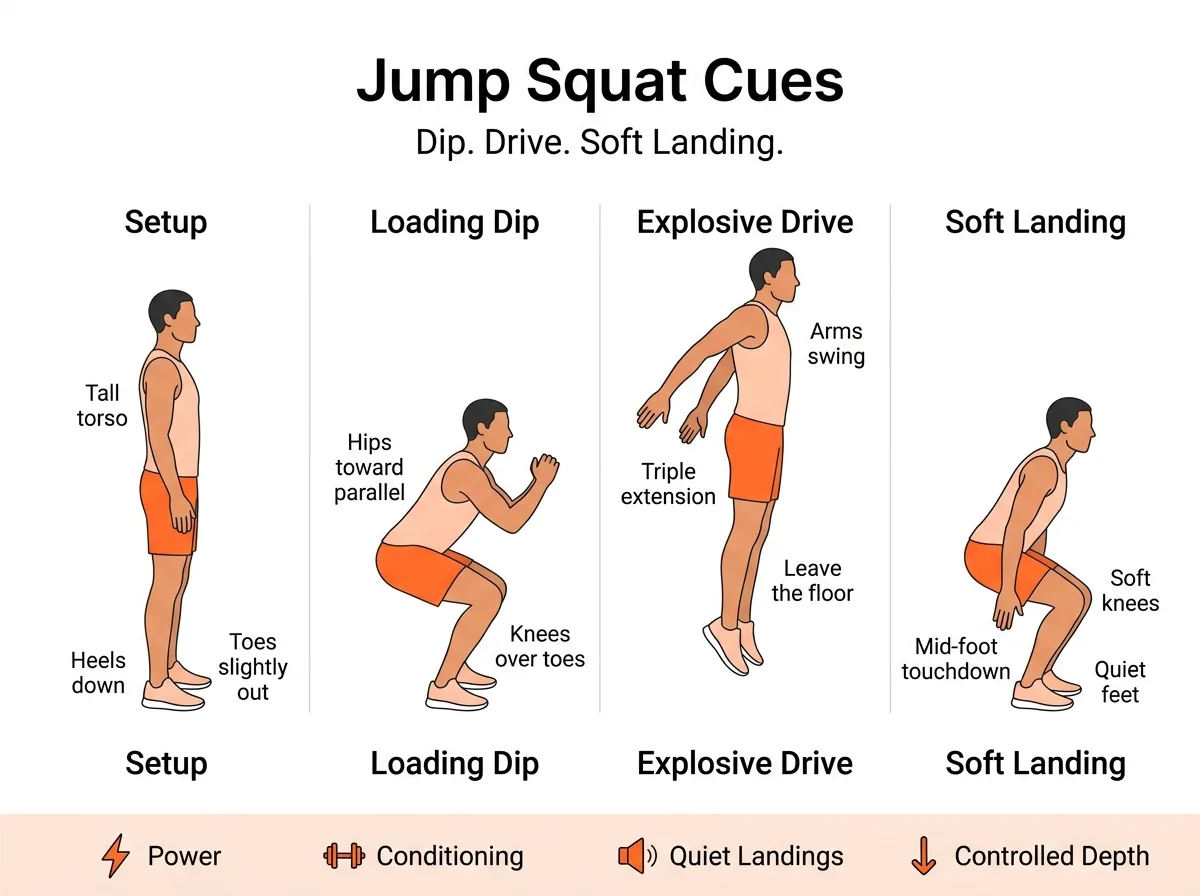
5-Point Jump Squat Form Checklist
Jump Squat Execution Checklist:
- Stance: Shoulder-width, toes slightly out (about 15°–30°).
- Dip: Sit hips back and down to roughly parallel—same depth you own on air squats.
- Drive: Explode upward through mid-foot; arms swing naturally for rhythm.
- Flight: Brief, tall posture in the air—avoid excessive forward lean.
- Land soft: Touch down mid-foot, knees soft and tracking over toes, then immediately load the next dip.
Step 1: Setup
Stand tall with feet under your hips or just outside shoulder width. Brace your core as if preparing for a light punch. Keep heels grounded during the dip phase.
Step 2: The loading dip
Descend under control for about one second until thighs approach parallel. Do not bounce out of a shallow quarter squat if your goal is a true jump squat pattern.
Step 3: Explosive extension
Drive hard through the floor, extending hips, knees, and ankles together (triple extension). Think “push the floor away,” not “yank the knees up.”
Step 4: Soft landing into the next rep
Land quietly. Absorb force by bending hips and knees as you touch down, then flow into the next dip. If each landing sounds like a stomp, cut height or volume.
Muscles Worked
| Muscle Group | Role in the Jump Squat |
|---|---|
| Quadriceps | Primary knee extension on takeoff and landing control |
| Gluteus maximus | Hip extension power out of the bottom |
| Calves (gastrocnemius / soleus) | Final ankle push and landing stiffness control |
| Hamstrings | Hip extension support and eccentric landing brake |
| Core | Trunk stiffness so force transfers upward cleanly |
| Hip abductors / external rotators | Help keep knees tracking over toes on landing |
4 Common Jump Squat Mistakes & Fixes
Mistake 1: Stiff, heel-crash landings
- Problem: Locked knees and loud heel strikes dump force into joints.
- Fix: Cue “quiet feet.” Land mid-foot with soft knees and an immediate small squat absorb.
Mistake 2: Knee valgus on takeoff or landing
- Problem: Knees cave inward under fatigue or poor hip control.
- Fix: Slightly flare toes, push knees out over mid-foot, and reduce jump height until tracking stays clean.
Mistake 3: Tiny hops with no squat depth
- Problem: The move becomes ankle bouncing, not a squat pattern.
- Fix: Require a clear parallel-depth dip before each jump. Film one set from the side if unsure.
Mistake 4: Rounding forward to “jump higher”
- Problem: Excess torso pitch wastes power and stresses the lower back.
- Fix: Keep ribs stacked over pelvis; use arm swing for rhythm, not a diving chest.
Progressions & Variations (Home-Friendly)
1. Squat to calf raise (low-impact power primer)
Stand from a squat and rise onto the balls of the feet without leaving the floor. Builds timing for triple extension with almost no landing shock.
2. Low-amplitude jump squat
Use a small hop (a few centimeters) while keeping depth honest. Ideal first jump progression.
3. Pause jump squat
Pause one second at the bottom, then jump. Removes rebound cheating and sharpens concentric power.
4. Banded jump squat (optional)
A light loop band around the thighs can cue knee tracking. Keep resistance modest so landings stay soft.
5. Squat to box jump (advanced pattern, separate skill)
If you use a box, treat box jumps as their own skill: step down to reset rather than rebound-jumping off a high box when fatigued.
Sample 10-Minute Jump Squat Conditioner
Warm up with 1–2 minutes of easy air squats and ankle rocks first.
| Block | Work | Rest | Notes |
|---|---|---|---|
| Low jumps | 6–8 reps | 45–60 s | Quiet landings only |
| Pause jump squats | 5–6 reps | 60 s | 1-second bottom pause |
| Interval finisher | 20 s jumps | 40 s easy march | 4 rounds max |
| Cooldown | Controlled air squats | — | 10 slow reps |
Perform 1–2 sessions per week on non-overlapping high-volume squat days if your joints feel fine. Swap jumps for air squats anytime quality drops.
Count Controlled Squats Hands-Free with MeshyFit
Jump squats are a great power finisher. For daily habit volume and depth accountability, most people still need clean, countable squat reps.
MeshyFit on iPhone helps you:
- Count workout / bodyweight squat reps on-device with depth-oriented validation for controlled reps.
- Train without uploading video — pose inference stays on device; frames are not stored for the cloud.
- Build consistency with challenges and weekly commitments rather than all-out plyo every day.
Honest bridge: treat jump squats as a conditioning variation. Use MeshyFit sessions for controlled squat sets where reps are clear stand-to-depth cycles; do not expect the app to score “flight time” or guarantee perfect plyometric phase detection.
Download MeshyFit for iOS and pair power finishers with countable habit volume.
Related Guides, Workouts & Variations
- Goblet Squat Form & Home Progression — Anterior-loaded depth builder.
- Sumo Squat: Wide Stance & Inner Thigh Focus — Adductor- and glute-biased stance.
- Dumbbell & Kettlebell Squats — Side-loaded, front-rack, and suitcase grip options.
- Beginner Squat Workout — Regressions before adding jumps.
- Squats for Legs & Quads — Quad-focused routines and intensity ideas.
- How to Squat Properly — Foundational stance and depth cues.
- Squat Calorie Calculator — Estimate energy cost of squat volume.
Frequently Asked Questions
- What is a jump squat and how is it different from a regular squat?
- A jump squat is a plyometric squat variation: you descend into a squat, then drive upward so both feet leave the floor, and land softly before the next rep. Compared with a standard bodyweight squat, it adds an explosive concentric phase and a higher landing impact, so it trains power and conditioning more than slow strength alone.
- What muscles do jump squats work?
- Jump squats primarily recruit the quadriceps, gluteus maximus, and calves (gastrocnemius and soleus) for takeoff, with strong support from the hamstrings, hip extensors, and core for landing stability. Fast-twitch fiber demand is higher than in controlled air squats because of the rapid stretch-shortening cycle.
- Are jump squats good for beginners?
- Beginners can use low-amplitude jump squats or squat-to-calf-raise progressions after they can do controlled bodyweight squats with stable knees and soft landings. If landings feel harsh or balance is poor, regress to air squats, pulse squats, or step-ups before adding full jumps.
- How many jump squats should I do?
- For conditioning, common beginner ranges are 3 sets of 6–10 quality reps with full recovery between sets, or short intervals such as 20 seconds of work and 40 seconds of rest. Stop a set when landings get noisy, knees cave inward, or depth collapses—quality beats high-rep thrashing.
- Do jump squats burn more calories than regular squats?
- Jump squats typically raise heart rate and metabolic demand faster than slow bodyweight squats because of the explosive effort and continuous impact. Exact calorie burn still depends on body weight, pace, and rest; use estimates as planning tools, not precise fat-loss guarantees.
- What are the most common jump squat mistakes?
- The top errors are: (1) landing stiff-legged with locked knees; (2) letting knees collapse inward on takeoff or landing; (3) cutting depth so the move becomes a tiny hop; and (4) chasing max height with a rounded torso. Fix with soft mid-foot landings, knees tracking over toes, and consistent parallel-depth dips.